Today, the Psychology Board has released a major consultation proposing a complete redesign of psychology education and training. The reforms are significant, but please keep in mind this is the first round of public consultation with nothing finalised and no implementation timeframes included.
The scale of change is significant, and the Psychology Board has rightly framed this as a once-in-a-generation reform of the profession.
One Shorter, Faster Degree for General Registration
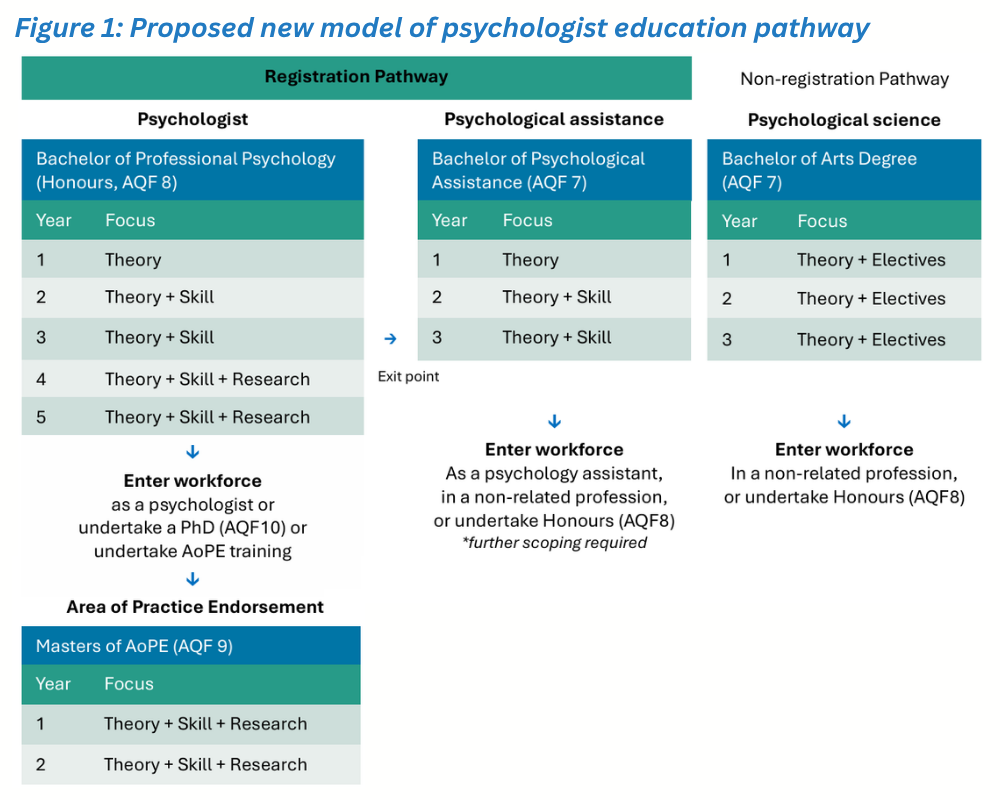
The headline proposal is a move to a single, streamlined pathway: a 5-year degree leading directly to general registration. This would include more practical skills training far earlier.
This would mean:
- No more +1 internship
- No more provisional registration (for domestic graduates)
- No more National Psychology Exam for domestic pathways
- Introduction of student registration instead
- Practical placements embedded into University courses
Moving to a single pathway and a single qualification opens the door to something the profession has long needed: more consistent and equitable training costs.
A single model creates the opportunity to align training under the same higher funding band, reducing financial barriers, inequities between pathways, and reliance on limited postgraduate places.
This has the potential to be a significant step forward for access and workforce supply, but there are missing details on what this will look like in reality, and AAPi will be analysing this proposal carefully.
Endorsement
The proposal separates the education and training pathways for general registration from endorsement and introduces a new model where endorsement becomes a standalone 2-year part-time Masters, completed while working in a relevant role. The registrar program would be removed and replaced with work-integrated training.
A key shift is that employer demand would help determine the need for advanced qualifications, signalling a move toward a more workforce-driven model of endorsement.
The Psychology Board has stated that all generally registered psychologists would be eligible to pursue endorsement through this new system. This will be a shorter and likely cheaper option than the current pathway to endorsement. Again, the full details are not included, and future reforms to endorsement have been flagged by the Psychology Board.
Psychology Assistants
The consultation also proposes a potential psychology assistant pathway, with an exit point after three years of study. The Psychology Assistant pathway and role will require further investigation and scoping. The Board has acknowledged that the role, demand, and structure remain unclear.
Key Questions and Considerations
While there are elements of the proposed model that may improve consistency and access, there are also a number of important questions and potential risks that require careful consideration.
AQF level and professional recognition
AAPi is concerned that the proposed 5-year pathway for general registration is currently called a Bachelor’s Degree and has been allocated an Australian Qualifications Framework (AQF) Level 8 qualification, whereas the current MPP (the 5+1 pathway) is an AQF Level 9.
AQF classification and qualification levels have real-world implications for how professions are recognised, including remuneration and industrial awards. The Fair Work Commission has recently recognised psychology as an AQF Level 9 profession, and we do not want to see psychologists with general registration take a backwards step in how their qualifications are valued.
AAPi raised this concern with the Psychology Board prior to the public release of these documents and will continue to seek clarity on how this risk will be addressed.
Removal of provisional registration
Provisional psychologists are currently a critical part of the workforce, contributing meaningfully to service delivery across many settings. While we acknowledge and do not want to minimise the challenges with the current internship model, the proposed removal of provisional registration raises important questions, including:
- What impact will this have on workforce capacity?
- How will services currently delivered by provisional psychologists be maintained?
- What transitional impacts might this have, particularly in already under-serviced areas?
There are also practical implications. For example, some funding schemes (such as the NDIS) currently allow services to be delivered by provisional psychologists but do not fund students on placement. This creates a potential gap that has not yet been addressed.
Placement capacity and accreditation
The proposed model relies heavily on embedded placements within university training. However:
- Will placement sites need to be formally accredited?
- Will smaller organisations or private practices be able to meet these requirements?
There is a risk that increased regulatory or administrative burden could reduce the number of available placement sites, particularly in smaller or rural settings, or in areas such as the NDIS which allows provisional registration, at a time when we need to expand, not contract, training opportunities.
Endorsement pathway clarity
The proposed endorsement model raises several unanswered questions:
- How does a psychologist secure employment in a “suitable role” for endorsement before undertaking the formal education required for that area of practice?
- What does it mean in practice for “employers and industry” to drive advanced qualifications?
- Will there still be flexibility for psychologists who wish to complete formal education first and then undertake supervised practice?
These details are critical to understanding how accessible and workable the new endorsement pathway will be in reality.
The two-tier system remains unaddressed
The most significant structural issue facing the profession - the two-tier system - has not been directly addressed in this consultation.
Without reform in this area, it is unclear what will materially change in terms of:
- Recognition of general registration
- Access to funding and roles
- Rebuilding and sustaining vital (and currently declining) areas of practice
Any changes to education and endorsement pathways must be considered in the context of this broader structural issue.
The consultation is also missing the implementation plan and timeframe. Without this information, it is difficult to fully understand the proposed reforms.
AAPi is asking members to engage in critical thinking about these and other areas regarding the proposed changes. We will be working hard to engage with members, stakeholders such as employers and universities, and the Psychology Board to achieve the most favourable outcome.
Psychology Board consultation opportunities
We encourage all members to carefully review the consultation information. Consultation is open until 10 June 2026. The Psychology Board will then review feedback and refine the model.
The Consultation Paper provides in-depth information on the project and the proposed model, while the Consultation Guide offers a general overview and key information.
Consultation paper
Consultation Guide
Attachment A – Public consultation submission template
This page includes a short video that walks through the proposed changes.
Detailed feedback to the Psychology Board is being accepted using the feedback submission template in Attachment A; submit the form by email to [email protected].
There is also a Psychology Board consultation survey.
The Psychology Board is also embarking on a ‘Listening Tour’, which will include webinars and in-person forums in all states and territories. You can register for this at the bottom of the consultation page here.
This is a significant reform agenda, and the details and implications matter. AAPi will continue to be actively engaged in the consultation, working with members to understand impacts, and advocating to ensure reforms improve access, strengthen the workforce, and support the full scope and value of psychologists. We will be directly consulting with members so we can represent your views and address any concerns.